

This Mediterranean tree is known for its tasty edible pods, but also for its ability to fix nitrogen in the soil and its resistance to drought - a real all-rounder!

The strawberry tree is a Mediterranean tree with a red, rough fruit that is a real delight to the eye and the palate. In addition to being highly appreciated in local gastronomy, the strawberry tree is a great ally for the restoration of forest ecosystems.

The majestic cedar is a tree of great stature and dense foliage, known for its hardy wood and intoxicating aroma. In addition, it is capable of fixing large amounts of CO2 in its trunk and branches.

Black pine is a species of pine commonly found on the Mediterranean coast. With its thick bark and long, flexible needles, it is able to withstand drought and forest fires.

The Spanish fir is an evergreen tree found exclusively in the mountains of southern Spain. With its elegant bearing and thick, dense foliage, it is a unique and very valuable species.

White rockrose is a Mediterranean shrub commonly found on poor, dry soils. With its lilac flores and velvety leaves, it is an important species in the regeneration of degraded soils.
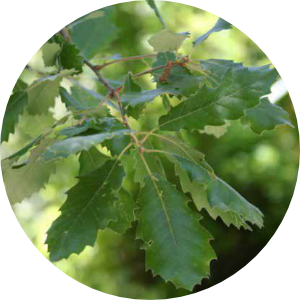
With its thick bark and dense, shady foliage, the gall oak is a robust tree that can grow in poor, rocky soils and provides shelter and food for a wide variety of wildlife.

Myrtle is an aromatic evergreen shrub commonly found in the Mediterranean region. With its fragrant leaves and small sweet berries, it is a popular species used for cooking and the making of traditional medicine.
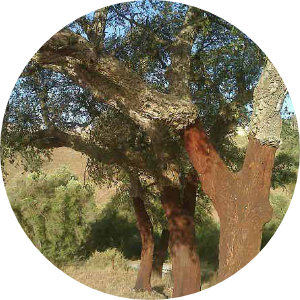
The majestic cork oak is one of the most emblematic trees of the Iberian Peninsula, known for its corky bark and its ability to store large amounts of CO2 in its leaves and branches.

Mastic is an evergreen shrub commonly found in the Mediterranean. With its leafy habit and red drupes, it is a valued species because it provides shelter and food for many animal species.

Olivilla is an evergreen shrub commonly found in the Mediterranean. With its fine leaves and small purple berries, it is a species valued for its medicinal properties and its ability to withstand cold and drought.
 Estepona is a Spanish municipality in the province of Malaga, Andalusia. In 2022, its population was 74,493 inhabitants, being a quarter of its population of foreign origin, mainly from the United Kingdom, Morocco and Argentina. Its municipal area has a surface area of 137.5 km² and extends along 23 km of coastline, with a fertile valley and a mountainous area, Sierra Bermeja, which reaches 1449 meters above sea level at the peak of Los Reales. The vegetation is composed of Mediterranean forest and scrubland, including the only forest of Spanish firs, an endemic species of the area, which grows on peridotites. There are also areas of pine forests, cork oaks, carob trees, strawberry trees and shrubs such as rockrose, thyme, mastic and rosemary. Estepona is located 82 km from Malaga and 48 km from Algeciras, and is bordered to the north by the municipalities of Jubrique and Júzcar, to the northeast by Benahavís, to the east by Marbella, to the southeast and south by the Mediterranean Sea, to the southwest and west by Casares and to the northwest by Genalguacil.
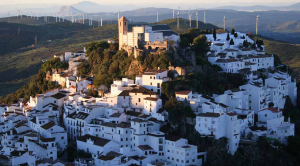 Casares is a municipality belonging to the province of Malaga, in the region of the Western Costa del Sol. According to the 2022 census data, its population is 7,700 inhabitants. The municipality has a surface area of 162.4 km² and is located in a mountainous area with a large area of Mediterranean forest and scrubland. The highest peak is Monte de Casares with 1,062 meters above sea level. In the municipality, the black pine is widely represented in the northeastern area in contact with Estepona. Although some are in good condition, others are in regression due to fires and human misuse. Aleppo pine and stone pine are mixed with black pine and Spanish fir, their distribution is conditioned by the microclimate and the nature of the soil. Among the evergreen formations, the presence of the cork oak, the holm oak, the carob tree and the wild olive tree stand out, with the cork oak mainly between 200 and 800 meters of altitude and on a calcareous substrate, and the holm oak with an abundant representation even in the highest altitudes of the area. The geology of the area is mainly composed of metamorphic and sedimentary rocks. Casares is located about 70 km west of Malaga and is bordered to the north by the municipality of Estepona, to the northeast by the municipality of Genalguacil, to the east by the municipality of Júzcar, to the south by the Mediterranean Sea and to the west by the municipality of Jimera de Líbar.
 Genalguacil is a municipality belonging to the province of Malaga, in the region of the Serrania de Ronda. According to the 2022 census data, its population is 393 inhabitants. The municipality has a surface area of 31.87 km² and is located in a mountainous area. Its highest points are the Pico de Los Reales (1,449 m.), Porrejón (1,210 m.) and the Peñas Blancas pass (1,010 m.). The vegetation of the area is mainly composed of coniferous forests; pine, Spanish fir and shrub species such as strawberry trees (Arbutus unedo L.), white heather (Erica arborea L.) and rockroses (Cistus sp.) And strictly endemic herbaceous species such as Staehelina baetica, Genista lanuginosa, Centaurea haenseleri, Centaurea Armeria colorata. The geology of the area is composed mainly of iron-bearing clays and peridotites. Genalguacil is located about 75 km northwest of Malaga, near the border with the province of Cadiz, and is bordered to the north by the municipality of Jubrique, to the northeast by the municipality of Gaucin, to the east by the municipality of Casares and to the west and south by the municipality of Estepona.
 Júzcar is a small municipality in the province of Malaga, also located in the region of the Serrania de Ronda. According to the 2022 census data, its population is 247 inhabitants. The municipality has a superficie of 33.66 km² and is located in a mountainous area. The highest peak is Mount Jarastepar (1,427 m.). The vegetation in Júzcar is very conditioned by the lithology, which leads to the existence of a large number of endemic species. Like other municipalities of its surroundings, it has masses of cork oak groves, gallery forests and chestnut trees, with a great ecological and landscape quality. The heathland makes up a large part of the surface of the municipality, and is made up of species that colonize the most stony slopes. Among the most characteristic species are rosemary, thyme and fern. As scrubland, the majuelo, mastic, juniper, kermes oak and wild asparagus stand out, and the most characteristic trees are the holm oak and wild olive. In the municipality are very characteristic chestnut forests, where chestnut trees are intermingled with cork oaks, oak forest and coniferous forest, where the endemic species resin pine is predominant. From the geological point of view, Sierra de Jarastepar is part of the external zone of the Betic mountain range in the external Penibetic. One of the fundamental characteristics of the outer Penibetic is its totally carbonate Jurassic series. The most extensive dolomite aflorments can be observed from the municipality of El Burgo, to the Sierra de Jarastepar itself, where sometimes the dolomitization affects the entire carbonate series. Júzcar is located about 90 km northwest of Malaga, near the border with the province of Cadiz, and is bordered to the north by the municipality of Jubrique, to the east by the municipality of Estepona, to the south by the municipality of Genalguacil and to the west by the municipality of Casares.